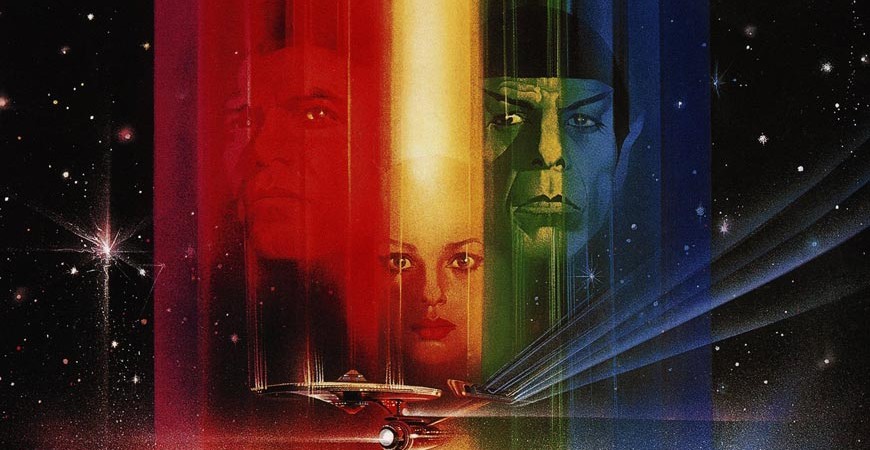
The human adventure is just beginning
I’ve had the argument for years. Most people think Star Trek: The Motion Picture is plain boring. I recently saw it described as “the motionless picture” in a writer’s blog. It’s considered slow. Ponderous. Monochromatic. Humorless.
The conventional wisdom holds that the second movie, The Wrath of Khan, is not only the best Star Trek film, it is also one of the greatest sci-fi films of all time. But I have to admit that — while I really enjoyed Khan — ST: TMP is, by far, my favorite of the eleven Trek movies.
Before you roll your eyes, please let me explain. For me it all boils down to one unifying idea — Star Trek: The Motion Picture is on a very small list of modern films that depict a powerful, beautiful, and original view of the future. I may not change your mind, but I hope you can experience the film through my eyes.
December, 1979
Think about the time when it was made.
It was 1979. Star Wars and Close Encounters graced the screen two years earlier. Superman: The Movie made us believe that a man could fly in 1978 and The Empire Strikes Back was just around the corner in 1980. For anyone with an imagination, it was a tremendous time to be alive and the golden age for blockbuster sci-fi cinema. But none of the aforementioned films mattered to me as much as Star Trek.
As a wide-eyed, twelve-year-old seventh grader, I probably had built up more excitement and anticipation for The Motion Picture than any other event in my entire life. My childhood heroes — Kirk, Spock, and McCoy — were about to grace the big screen! What would the Enterprise look like? Would they change it? How would it look flying through space with modern visual effects? I was so excited to see what they would do with a big budget.
Once I started seeing the commercials, I went nuts. I remember the voice of Orson Wells: “It will alter your perception of the future by taking you there.” That was what I wanted to hear. The FUTURE. Finally, a film about the future!
Star Wars took place “a long time ago, in a galaxy far, far away.” What did that have to do with me? I felt like I was finally going to get what I wanted from a film: a real depiction of human potential hundreds of years in the future.
I had seen 2001: A Space Odyssey a few years earlier. It was the first honest tour of tomorrow that I had ever seen. It seemed very possible and right around the corner based upon what had been happening with NASA’s space program. Krypton in Superman was really, really cool. But again, that was an alien planet with magical technology. I wanted to see something that connected to Earth and, ultimately, to me.
Star Trek: The Motion Picture delivered exactly what I was looking for. While 2001 showed me the world that I expected to live in as an adult, Star Trek promised to reveal a future of my dreams.
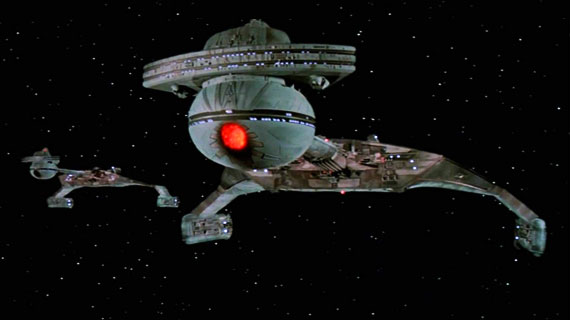
Finally, It Arrives in Theatres
When I saw the film with my cousin James, we were mesmerized from the first moment. Seeing the camera do a 180-degree pan of the updated Klingon cruisers as they approached a huge blue luminescent cloud blew my mind. Once we were inside the ships, I was sucked in by the production design. Clear screens with data projected on them. Actual Klingon language graphics on screen — not English! Then we moved on to the Epsilon 9 space station with astronauts jetting around outside. I was blown away, and this was just the beginning.
After a quick and epic stop at Vulcan to visit a hippie version of Spock, I finally got to see what I had been waiting for: Earth in the future. You see, when I watched the original Star Trek as a child, I always wanted to see what Earth looked like in the 23rd Century.
Yes, it was cool to travel around the galaxy seeking out new life, but I wanted to know what it was like at home. It always felt like they avoided it due to budget or something. And, no; visits to Earth in the 1960’s didn’t count.
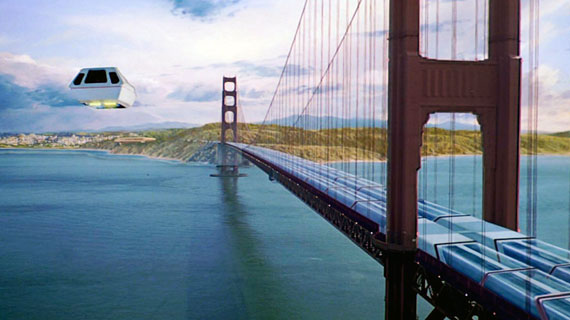
Earth in the 23rd Century
Now, here was Starfleet Headquarters in San Francisco. The Golden Gate Bridge covered by pneumatic travel tubes. Shuttles flitting across the sky as routinely as a buses travel the streets. We then move to an orbiting office complex bustling with traffic; followed by an extended drydock sequence that reveals the Enterprise in all of its futuristic glory.
Speaking of the Enterprise, Andrew Probert took Matt Jeffries’ original design and blew it out of the water. The clean lines and details make this still the best ship to ever grace a Star Trek film or TV series.
For the first time, we’re able to ascertain the actual size of the ship. As Admiral Kirk and Scotty circle in a travel pod, the front window is large enough to see them inside. This — when mixed with the floating astronauts and traffic — gives us a real sense of scale. It was like going to the airport, and watching the airplanes and ground crews. There is something magical about it.
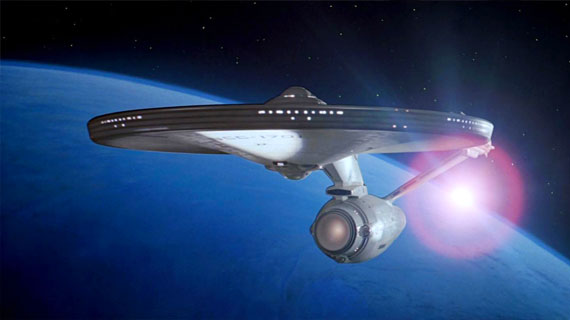
The ultimate sequence was the launch of the Enterprise. A tiny astronaut waving goodbye. The sun rising as the ship cruises away. Seeing Earth dwindle in the viewscreen as Sulu takes them to impulse. Shooting past Jupiter and its moons was awe inspiring. All of these aspects felt like a love letter to us from the future. I felt like I was finally there.
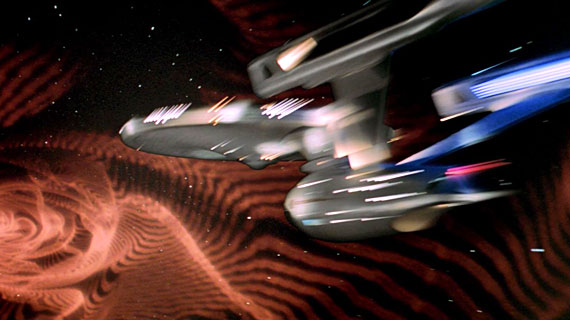
The sets and costumes were amazing. Every aspect felt rich and fully realized. The visual effects were spectacular. Each time the Enterprise went into warp speed, I was left speechless. It was even more amazing than watching the Millenium Falcon jump into hyperspace.
The icing on the cake was the final reveal of who/what V’ger really was — an evolved NASA space probe that had returned home after a galaxy-spanning adventure. The fact that the core concept was about exploration and connected to Voyager — a real planetary mission at the time — was validating and inspiring.
The only complaint I had about the film was that the plot reminded me of the Original Series episode called “The Changeling” where the Nomad probe went through a similar conversion. But I could forgive this.
A Futuristic Work of Art
All in all, seeing Star Trek: The Motion Picture was the greatest experience I had ever had at the time. My cousin James and I were blown away when it was over. As this was not the time of instant mp3 downloads, we drove back from the theater singing the theme over and over in an attempt to remember it. We must have driven my Aunt Cecelia crazy.
The soundtrack by Jerry Goldsmith remains legendary to this day. Few sci-fi films have ever topped it. In fact, I was ecstatic when Gene Roddenberry chose to use the theme for The Next Generation in 1987. I still listen to it often.
Roddenberry wanted to tell this story. He was inspired by the future and wanted to share that vision with the world. He finally had the budget, and the team to do it right.
Director Robert Wise, the actors, and the production staff — which included effects wizards Douglas Trumball of 2001 and John Dykstra of Star Wars — crafted a beautiful journey to tomorrow. It moved at a thoughtful pace so that the audience could take everything in. There was art transpiring on the screen; it like a classic painting — you don’t just scan it for two seconds and walk away.
All I ask is that you revisit the film and give it another chance. This time, look around. Take it in. You might find that you like it a little more than you expect.